The Short Version (Key Takeaways)
- Texas homeowners insurance averages $4,085/year in 2026 — about 60% above the national average.
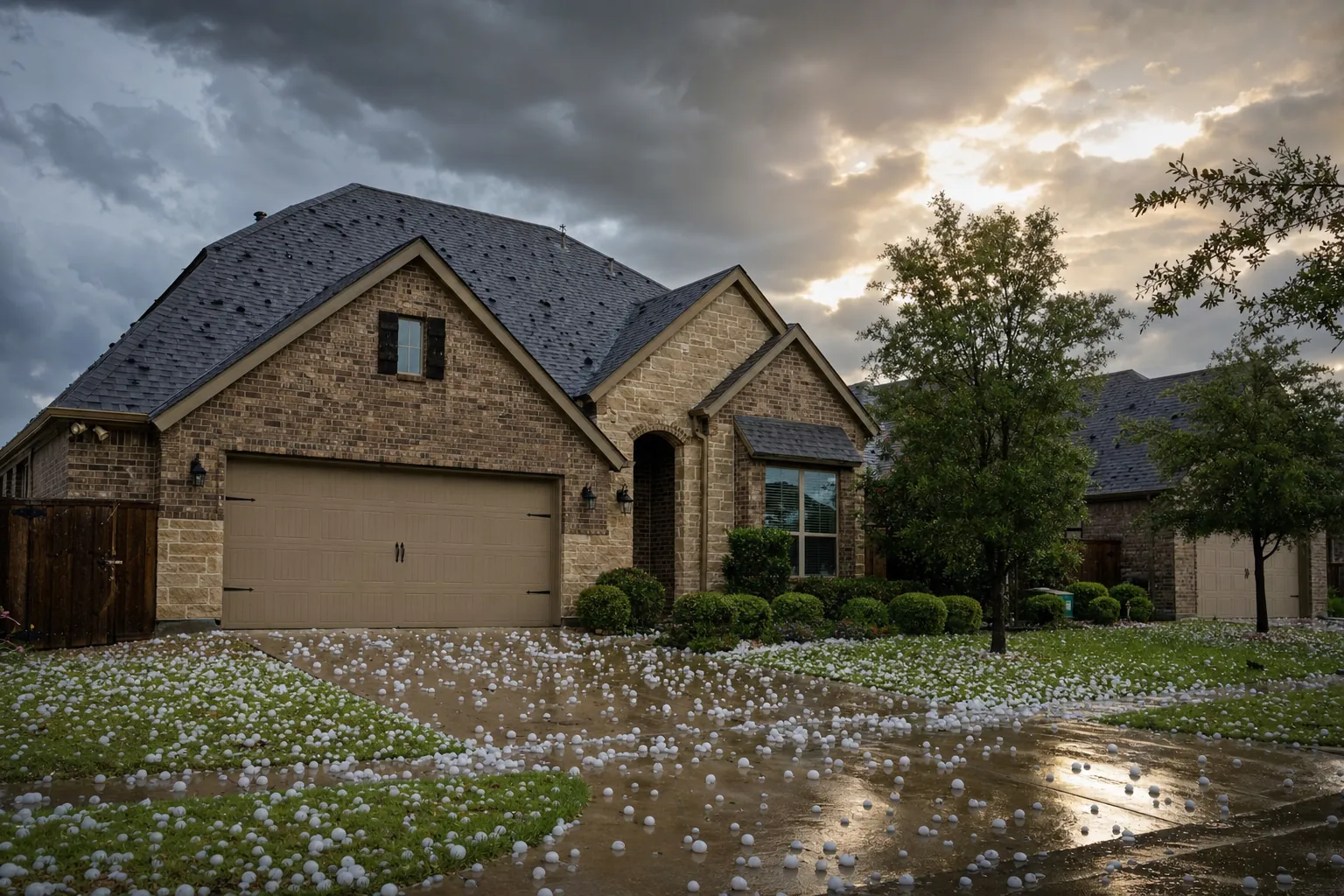
- Hail accounts for roughly 70% of Texas homeowners claim dollars. This isn't a rare event risk — it's the main event.
- Most Fort Worth policies now carry a wind/hail deductible of 1-2% of your dwelling coverage, not a flat dollar amount. On a $400,000 home, that's $4,000-$8,000 out of pocket before your insurer pays a dime.
- A Class 4 impact-resistant roof can cut your premium 10-28% — often enough to pay for the upgrade over time.
- Fort Worth sits in a corridor that sees 5-10 significant hail events per year.
- Check your declarations page today. If you don't know your wind/hail deductible percentage, call us: 817-922-8031.
Why Fort Worth Homeowners Insurance Costs So Much
Fort Worth sits at the southern edge of what meteorologists sometimes call "Hail Alley's" Texas cousin — the DFW corridor gets slammed by supercell thunderstorms rolling off the Texas Panhandle and Tornado Alley almost every spring and early summer. The National Weather Service and insurance industry data both point to the same pattern: North Texas sees 5-10 significant hail events a year, and Tarrant County is regularly in the bullseye.
Insurers have been pricing this in for well over a decade. Every roof replacement claim, every siding repair, every cracked window from a golf-ball-sized hailstone gets fed into actuarial models, and those models have pushed Texas premiums well above the national average. That's not an accident or an overcorrection — it's Texas weather being Texas weather, and insurers responding to real claims data, not hypotheticals.
If you're comparing your Fort Worth quote to what your cousin in Ohio pays, stop. It's not the same risk pool.
The Wind/Hail Deductible Change That Blindsides People
Here's what catches a lot of Fort Worth homeowners off guard: your wind/hail deductible is probably not what you think it is.
Years ago, most policies had a flat wind/hail deductible — something like $500 to $2,500, same as your all-other-perils deductible. That's largely gone. Today, the standard structure on most Texas policies is a percentage-based deductible, typically 1-2% of your dwelling coverage limit — and that percentage applies specifically to wind and hail claims, separate from your regular deductible.
Do the math on a typical Fort Worth home:
- $300,000 dwelling coverage, 2% deductible = $6,000 out of pocket
- $400,000 dwelling coverage, 2% deductible = $8,000 out of pocket
- $400,000 dwelling coverage, 1% deductible = $4,000 out of pocket
That's a meaningful difference, and a lot of homeowners have no idea which percentage they're carrying until a storm hits and they're staring at a claim estimate. Pull out your declarations page right now and look for "Wind/Hail Deductible" or "Named Storm Deductible." If it's written as a percentage, do the math against your dwelling limit. If you can't find it or don't understand it, that's exactly the kind of thing we walk through with people at no cost — call 817-922-8031.
Do Not File a Small Hail Claim
This surprises people, but it's true: filing a claim for minor hail damage is often a bad financial move.
Every claim you file — paid or not — goes into a CLUE report (Comprehensive Loss Underwriting Exchange), a shared database that insurers pull when quoting you. That claim stays on your CLUE report for seven years, and insurers use it to price your renewal or decide whether to renew you at all. File two claims in a short window and non-renewal becomes a real risk, even in Texas where hail is common and insurers expect some claims.
So when is a hail claim actually worth it? Generally:
- The roof needs full replacement, not just a few shingles
- There's structural damage — damaged decking, compromised flashing, water intrusion
- Repair costs will clearly exceed your deductible by a wide margin
If a contractor's quote is a few hundred dollars over your deductible, you're often better off paying it yourself and keeping your claims history clean. This is a judgment call worth making with someone who isn't trying to sell you a new roof — talk to your agent, not just the roofer who knocked on your door after the storm.
The Class 4 Impact-Resistant Roof Discount
If you're re-roofing anyway — after a legitimate claim or just due to age — ask about Class 4 impact-resistant shingles. These are rated under UL 2218 testing to withstand hail impact without cracking, and most Texas insurers offer a 10-28% premium discount for having one installed.
Rough math: on a $4,000/year policy, a 20% discount saves $800/year. A Class 4 roof upgrade typically costs a few thousand dollars more than a standard architectural shingle roof at installation — meaning the discount alone can pay back the upgrade cost within a few years, well before you'd need to replace the roof again (20-30 year typical lifespan). Carriers that commonly recognize this discount in Texas include Travelers, Safeco, and several of the regional Texas-focused carriers we work with — availability and discount size vary by company, which is exactly why comparing carriers matters here.
HO-3 vs HO-5 for Fort Worth Homes
Most Fort Worth homeowners are on an HO-3 policy — open-perils coverage on the dwelling itself, but named-perils only on personal property (contents). That means your house structure is covered against anything not specifically excluded, but your belongings inside are only covered against a specific list of causes.
An HO-5 policy upgrades your personal property to open-perils as well, matching the dwelling coverage. For higher-value Fort Worth homes — especially in neighborhoods like Mira Vista, Tanglewood, or Westover Hills — this is worth considering. The price difference is usually modest relative to the added protection, and it closes a real gap: HO-3 contents coverage can leave you exposed for losses that don't fit neatly into the named-perils list.
The practical difference shows up in edge cases. Say a contractor accidentally damages your flooring while doing unrelated work, or a moving mishap cracks a piece of furniture. Under HO-3's named-perils contents coverage, you'd need the cause of loss to match one of the specifically listed perils — and if it doesn't, you're not covered. Under HO-5, you're covered unless the cause is specifically excluded. For most day-to-day claims the difference is academic, but for the unusual ones, it's the entire difference between a paid claim and a denied one.
What's Actually Covered
A standard Fort Worth homeowners policy includes:
- Dwelling coverage — the structure itself
- Other structures — detached garage, fence, shed
- Personal property — your belongings
- Loss of use — hotel/living costs if your home is uninhabitable during repairs
- Liability — if someone is injured on your property
- Medical payments — smaller, no-fault medical coverage for guests
What's not covered, and where people get burned:
- Flood — never included in a standard homeowners policy, always requires separate NFIP or private flood coverage
- Earthquake — separate endorsement or policy
- Mold — usually capped at a low sub-limit ($1,000-$5,000) unless it results directly from a covered peril
- High-value items — jewelry, art, and collectibles often have low sub-limits ($1,000-$2,500) unless you add a scheduled endorsement
That last one trips people up more than you'd expect. A lot of homeowners assume their engagement ring or a few thousand dollars in tools in the garage are simply "covered" because they own a homeowners policy. In reality, most policies cap categories like jewelry, firearms, and business equipment well below replacement value unless you specifically schedule those items. If you own anything individually worth more than a couple thousand dollars, ask us about a scheduled personal property endorsement — it's usually inexpensive relative to the value it protects.
Day-After-a-Storm Checklist
If hail hits your neighborhood, here's the order that protects you best:
1. Photograph everything before touching anything — roof, gutters, siding, AC unit, fencing, vehicles. 2. Save damaged materials — a piece of damaged shingle or gutter can matter later. 3. Get an independent roof inspection first — not one referred to you by a door-knocking contractor or your insurer's preferred vendor. An independent inspector works for you, not for a claims quota. 4. Then call your insurance company, armed with photos and an honest assessment of scope. 5. Document every conversation — date, adjuster name, what was said.
Storm chasers descend on Fort Worth after every major hail event, and some push homeowners into unnecessary claims or inflated repair scopes. Get your own read on the damage first.
How Rainbow Handles Fort Worth Home Insurance
We're an independent agency, which means we're not trying to fit you into one company's underwriting box. We compare your home across more than 56 insurance carriers and markets, review your wind/hail deductible percentage specifically (not just your premium), hunt for the Class 4 roof discount if you qualify, and check whether bundling with your auto policy saves you 5-15% — often it does, sometimes it doesn't, and we'll tell you either way.
See our main Fort Worth home insurance page for coverage details, or check out our Arlington home insurance and Plano home insurance pages if you're weighing a move.
Ready for Real Coverage?
Storm season doesn't wait, and neither should your coverage review. Call Rainbow Insurance Agency at 817-922-8031 or stop by our office at 2209 8th Ave, Fort Worth, TX 76110. We've served DFW since 1993, we compare more than 56 insurance carriers and markets, and yes — hablamos español.
Frequently Asked Questions
How much is home insurance in Fort Worth in 2026?
Typical range is $3,500-$5,000/year depending on home value, roof age, and construction. The Texas statewide average is $4,085/year.
What is a wind/hail deductible?
It's a separate, usually percentage-based deductible (1-2% of your dwelling coverage) that applies specifically to wind and hail claims, distinct from your regular all-other-perils deductible. On a $400,000 home at 2%, that's $8,000 before coverage kicks in.
Does home insurance cover roof leaks?
Only if the leak results from a sudden, covered peril like a storm or falling tree. Leaks from ordinary wear-and-tear or age are not covered — insurers expect routine maintenance to prevent those.
Is flood covered?
No. Flood is always excluded from standard homeowners policies and requires a separate NFIP or private flood insurance policy, regardless of where you live in Fort Worth.
Should I file a hail claim for minor damage?
Almost always no. Small claims stay on your CLUE report for 7 years and raise your non-renewal risk. Save claims for damage that clearly exceeds your deductible by a wide margin.
What is a Class 4 roof?
A roofing material rated under UL 2218 testing for impact resistance to hail. It typically earns a 10-28% premium discount and lasts 20-30 years before replacement.