The Short Version (Key Takeaways)
- SR-22 is a filing, not a policy — it's the state's proof that you carry the insurance Texas requires
- Filing fee: $15-50 one-time in Texas
- Monthly premium: varies by carrier and driving history
- Required duration: 2 years continuous, no lapses
- Rainbow files SR-22 electronically with Texas DPS
- Call 817-922-8031
What SR-22 Actually Is (And Isn't)
Most people who need an SR-22 have never heard of it until a court clerk or a letter from the state mentions it — and the name makes it sound like some special, expensive type of insurance. It isn't.
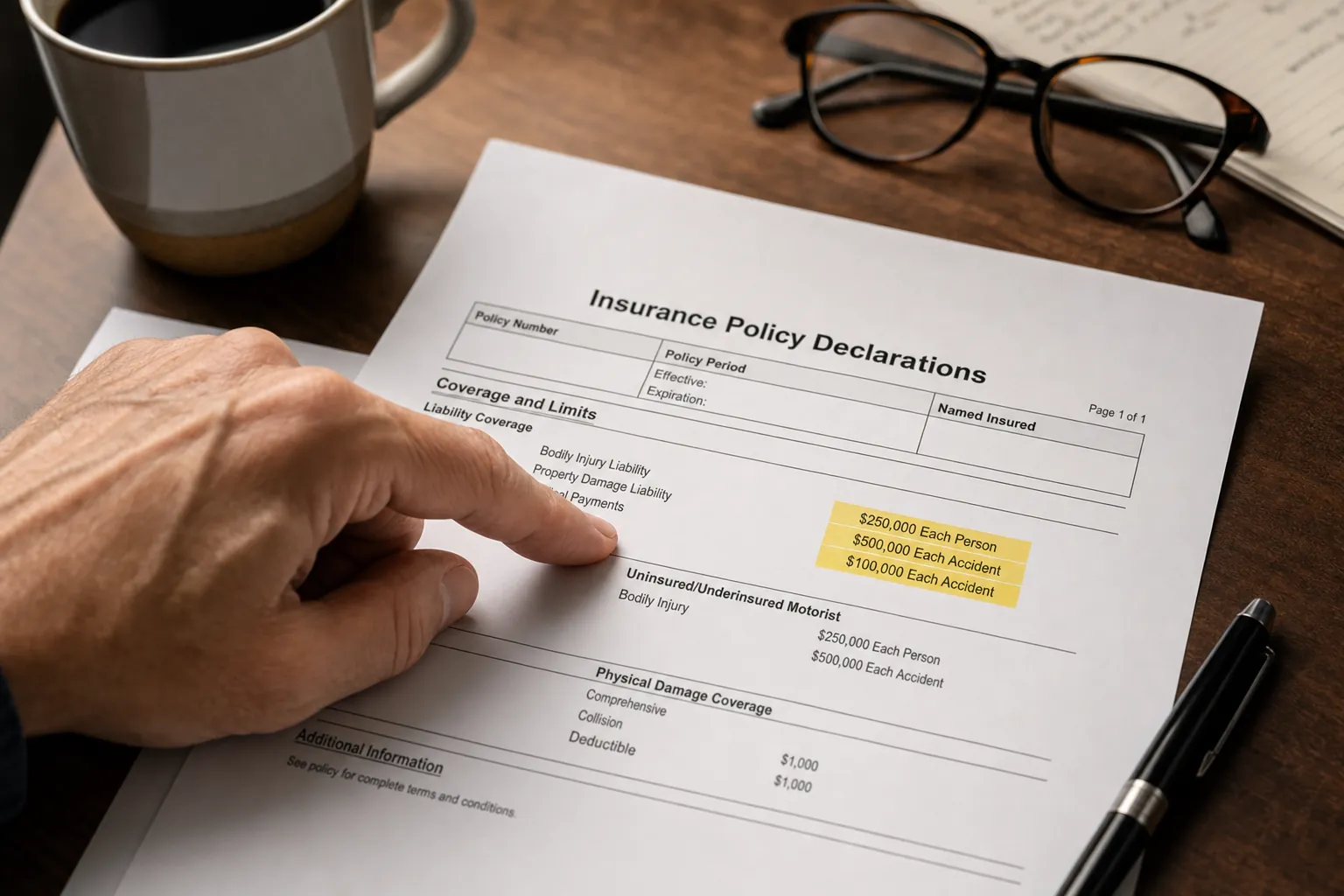
An SR-22 isn't a policy at all. It's a form your insurance company files with the Texas Department of Public Safety, certifying that you're carrying the liability coverage the state requires. Think of it less like a product and more like a receipt stapled to a policy you already have — it just proves to the state that the policy exists and meets the minimum limits.
In Texas, you'll sometimes hear this called an SR-22 form or a Financial Responsibility Filing. Same thing, different name. Your insurer handles the paperwork; you just need a policy that qualifies and an insurer willing to file it.
Here's where the confusion usually comes from: people assume "SR-22 insurance" must be a special, higher-priced product built just for high-risk drivers. It's not a separate product line at all — it's a standard auto policy (liability-only or full coverage, your choice) with one extra form attached. The reason SR-22 drivers often pay more isn't the filing itself; it's that whatever landed them in SR-22 territory in the first place — a DWI, a lapse, an at-fault accident — already flagged them as higher risk in the insurer's eyes. The filing is just paperwork. The rate increase is about the underlying record.
Why You Might Need SR-22 in Texas
Texas doesn't require SR-22 for everyone — it's tied to specific situations, almost always triggered by a court or DPS after something goes wrong on your driving record. The most common reasons people end up needing one:
- A DWI or DUI conviction
- Getting caught driving without insurance
- Multiple at-fault accidents while uninsured
- A license suspension or revocation
- Failing to pay a court-ordered judgment after an accident
- A pattern of habitual traffic violations
The good news, if there is any: you almost never have to figure out on your own whether you need an SR-22. The court or Texas DPS will notify you directly, usually with a letter that specifies the filing requirement and deadline. Your job at that point is just finding an insurer who can file it correctly and quickly — miss the deadline and you risk an extended suspension on top of whatever triggered the requirement in the first place.
One thing worth knowing up front: not every insurer files SR-22s. Some carriers simply don't handle them, which is why a lot of people who've been with the same company for years suddenly find out their insurer can't help once they need this specific form. That's usually the point where people start shopping around, often for the first time in a decade.
2026 SR-22 Cost Breakdown
Here's what SR-22 coverage actually costs across major carriers in 2026, based on Insurify data:
| Carrier | Liability-Only Monthly | Full Coverage Monthly |
|---|---|---|
| State Farm | $67 | $148 |
| Allstate | $91 | $179 |
| GEICO | $100 | $188 |
| Progressive | $118 | $196 |
| National General | $123 | $204 |
| Bristol West | $113 | $218 |
| First Acceptance | $98 | $240 |
| GAINSCO | $109 | $208 |
On top of the monthly premium, there's the filing fee itself — typically $15-50, paid once when your insurer submits the SR-22 to the state.
Why does the monthly premium swing so much between carriers? A few factors do most of the work: your age, your ZIP code, your driving history (including whatever triggered the SR-22 requirement), and — where Texas law allows it — your credit tier. Two people with identical violations can get quotes $60/month apart just based on which carrier happens to price their risk profile favorably.
Fort Worth specifics: ZIP codes in Fort Worth run about 2% above the Texas state average for SR-22 premiums, which is a modest bump compared to some DFW suburbs. It's still worth shopping around rather than accepting the first quote — comparing rates across carriers is usually where the real savings show up, not in negotiating with a single insurer.
One option a lot of people don't know exists: the non-owner SR-22. If you need to prove financial responsibility but don't currently own a car — maybe you borrow vehicles, rent, or drive a company car — a non-owner policy satisfies the requirement without paying for coverage on a vehicle you don't have. It averages $40-90/month in Texas, or roughly $614/year.
It's also worth noting that the numbers above are averages, not guarantees. Two drivers with the exact same violation can land on very different premiums once age, ZIP code, and prior claims history get factored in. A 22-year-old with a first DWI in a Fort Worth ZIP code is going to see a different quote than a 45-year-old with an otherwise clean 20-year record who had one lapse in coverage. That's exactly why getting several quotes matters more here than with a standard policy — the spread between the cheapest and most expensive carrier for the same driver is often $50-100 a month.
The 2-Year Clock
Texas requires SR-22 filing for 24 continuous months. The word "continuous" is doing a lot of work in that sentence — if your coverage lapses for even a day, two things happen immediately: your insurer notifies DPS that the policy lapsed, and your 24-month clock resets to zero. You start over.
If your license gets suspended because of a lapse, reinstating it costs a $100 minimum reinstatement fee, on top of whatever it costs to get your coverage back in force.
Avoiding a lapse is mostly about not letting life get in the way of a payment:
- Set up auto-pay so a missed due date isn't possible
- Put calendar reminders a few days before each payment, as a backup
- Be especially careful during job changes or moves — those are the two most common reasons people accidentally let a policy lapse
Two years of perfect payment history is a much better outcome than three separate 8-month stretches interrupted by resets. It's also worth telling your agent right away if you're moving or switching jobs — a quick heads-up lets them make sure your payment method and mailing address stay current, instead of a bounced auto-pay quietly turning into a lapse you don't notice for weeks.
Non-Owner SR-22: The Underused Option
If you don't own a vehicle right now, a standard SR-22 auto policy isn't necessarily your only path — and it's often not the cheapest one either. A non-owner SR-22 policy exists specifically for this situation, and a surprising number of people who qualify never hear about it.
Here's when it makes sense:
- You lost your license and need to prove financial responsibility to get it reinstated, but you sold your car or never owned one
- You regularly drive borrowed vehicles, rentals, or a vehicle your employer provides
- You want the cheapest legal way to satisfy the SR-22 requirement while you're between cars
Cost-wise, it's meaningfully cheaper than a full policy — averaging $40-90/month in Texas. It covers your liability when you're behind the wheel of someone else's vehicle, which satisfies what the state actually cares about: that you're financially responsible if you cause an accident.
Once you buy a car, you'll need to switch to a standard SR-22 policy that covers that specific vehicle — a non-owner policy won't extend to a car titled in your name. Rainbow can help make that switch without creating a coverage gap, which matters given the lapse rules above.
A non-owner policy also tends to be the right call for people rebuilding after a suspension who aren't ready to commit to a car payment yet. It lets you satisfy the state's requirement, keep driving legally when you do get behind the wheel, and hold off on buying a vehicle until your finances — and your driving record — are in better shape.
How Rainbow Handles SR-22 in Fort Worth
Filing an SR-22 shouldn't take days, and it shouldn't require you to understand insurance jargon to get it right. Here's how we do it:
- Electronic filing with Texas DPS — no waiting on the mail, no manual paperwork sitting on someone's desk
- We compare rates from more than 56 insurance carriers and markets to find competitive SR-22 rates for your specific situation, rather than pushing you toward one insurer
- Bilingual service — hablamos español
- We're an independent agency, not locked into selling one company's policies
- Located at 2209 8th Ave in Fort Worth, serving all of DFW since 1993
Call 817-922-8031 — most people get a quote in about 5 minutes.
We've been doing this in Fort Worth since 1993, which means we've filed SR-22s through several rounds of Texas DPS system changes and know exactly what the state needs to process a filing without kickbacks or delays. That matters more than it sounds like it should — a filing with a typo or missing detail can sit in limbo for days, and if you're driving on a suspended license waiting for it to clear, that's not a risk worth taking.
Ready to File?
If you've got a court date, a DPS letter, or just need to get legal again, don't wait on it — every day without an SR-22 on file is a day your license stays at risk.
Call 817-922-8031 or stop by 2209 8th Ave, Fort Worth, TX 76110. We serve Fort Worth, Arlington, Grand Prairie, Irving, Garland, Mansfield, Plano, Frisco, Dallas, and all of DFW.
Hablamos español.
Frequently Asked Questions
How long does an SR-22 stay on my record in Texas?
Texas requires 24 continuous months of SR-22 filing. Once you complete the requirement without lapses, your insurer files an SR-26 to notify the state you no longer need it.
Will my rates go back down after the 2 years?
Not immediately, but yes over time. The violation that caused the SR-22 (DWI, uninsured driving, etc.) affects your rates for 3-7 years depending on severity. Once it drops off your record, you can re-shop and typically save 30-50%.
Can I get SR-22 without owning a car?
Yes — it's called a non-owner SR-22 policy. It covers you when driving borrowed, rented, or employer vehicles, and averages $40-90/month in Texas.
What happens if my SR-22 lapses?
Your insurer notifies Texas DPS the day coverage ends. Your license is suspended immediately, and the 2-year clock restarts once you reinstate. Reinstatement fees are $100 minimum.
How fast can Rainbow file my SR-22?
We file electronically with Texas DPS upon policy binding — no waiting for physical mail or manual paperwork. Call 817-922-8031 to get started.
Can I switch insurance companies while on SR-22?
Yes, but coordinate the switch carefully. The new insurer files an SR-22 on day one of your new policy, and the old insurer files an SR-26 the day yours ends. Any gap between = lapse = clock resets.